- HOME
- Departments & Centers
- Oncology
Oncology
Message from the representative
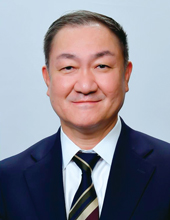
Physician-in-chief, Oncology Department
Senior Professor of Clinical Oncology, IUHW School of Medicine
HIGUCHI Hajime, M.D., Ph.D.
Our hospital is staffed by four board-certified medical oncologists. Guided by our motto, “Compassionate cancer care where medical treatment and palliative care go hand in hand,” we provide state-of-the-art treatments.
To reap the full benefits of cancer drug therapy, it is crucial to effectively alleviate suffering and symptoms, such as cancer-related pain and treatment side effects, so patients can undergo treatment in optimal condition. Anticancer drug therapy and palliative care share the common goal of "improving treatment outcomes" and should be conducted simultaneously, like the two wheels of a cart.
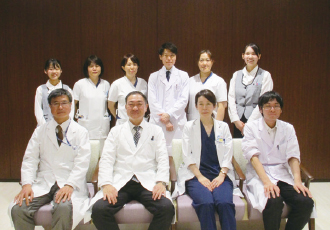
At our hospital, specialists in drug therapy and palliative care collaborate closely, and our medical staff provide care with a shared purpose. A key feature of our department is our system in which a single team manages the care of most inpatients and outpatients, enabling us to provide high-quality, team-based care.
Cancer care has evolved from an era in which a single physician managed nearly all aspects of a patient’s condition to an era of multidisciplinary, team-based care. As the affiliated hospital of the International University of Health and Welfare, responsible for training healthcare professionals, we leverage this strength in our cancer care.
- If you have been diagnosed with cancer and are concerned about your future treatment, please visit our department.
- If you have been diagnosed with cancer of unknown primary origin (where metastases have been found, but the primary tumor cannot be located), and wish to discuss treatment options, please visit our department.
- If you have been diagnosed with a rare cancer, such as soft tissue sarcoma, neuroendocrine tumors, or thyroid cancer, and are worried because you have heard that there are few treatment options or medications available, please visit our department.
- If you are concerned about cancer - for example, if you have a family history of cancer or were told during a comprehensive health screening that there is a suspicion of cancer - and wish to undergo further testing, please visit our department.
Our staff will do their utmost to assist you.
Main target diseases
Esophageal cancer, stomach cancer, colorectal cancer, rectal cancer, liver cancer, pancreatic cancer, biliary tract cancer(gallbladder and bile duct cancer), breast cancer, ovarian cancer, uterine cancer, neuroendocrine cancer, sarcoma, and cancer of unknown primary origin. We also treat neoplastic diseases of all organs.
Highlights of the department
Holistic cancer care
Our "specialists in cancer chemotherapy," supported by "board-certified general internists" capable of treating elderly patients and those with diverse internal medical comorbidities, provide the best possible treatment tailored to each patient's condition-from standard to advanced therapies-across all organ systems.
For gastrointestinal and breast tumors in particular, physicians certified as “gastroenterologists” or “breast specialists” provide care.
In collaboration with the Department of Rehabilitation, we emphasize geriatric oncology care based on comprehensive functional assessments of the elderly. We collaborate with the IUHW Institute of Medical Genomics and the Keio University Hospital, a core facility for cancer genomics, to provide cutting-edge treatments and diagnostic tests.
Outpatient chemotherapy team
Our outpatient chemotherapy team provides comprehensive cancer care through a multidisciplinary approach. The team comprises medical oncologists(including two board-certified medical oncologists), certified oncology chemotherapy nurses, certified oncology pain management nurses, and certified outpatient oncology pharmacists.
We emphasize preventing the side effects of anticancer drugs. Through supportive therapies such as cooling gloves and socks to prevent peripheral neuropathy and aromatherapy massage and relaxation techniques to address fatigue and loss of appetite, we aim to maintain patients’ quality of life.
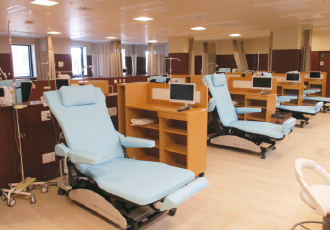
Outpatient chemotherapy unit
The unit has 28 reclining chemotherapy chairs and 12 treatment beds for a total of 40 beds. It is equipped with amenities such as TVs and DVD players.
Palliative care
Cancer treatment and palliative care go hand in hand. Alleviating symptoms such as stress, pain, anxiety, and insomnia caused by the disease is important for improving treatment outcomes. Our hospital has a palliative care team composed of staff well-versed in palliative care, including physicians, nurses, pharmacists, social workers, and clinical laboratory technologists. They provide palliative care for cancer patients on an inpatient and outpatient basis. We collaborate closely with the palliative care team to minimize the physical and emotional toll of cancer treatment.
Specialized outpatient services for pancreatic tumors and cysts
Our department is dedicated to treating advanced cancer and to efforts for early detection. Regarding gastrointestinal cancers in particular, our specialists perform early diagnosis and screening. In addition to imaging tests such as CT scans, MRIs, and PET-CT scans, we perform upper gastrointestinal endoscopies, colonoscopies, endoscopic retrograde cholangiopancreatographies(ERCPs), and endoscopic ultrasounds(EUSs).
We emphasize the early detection of pancreatic cancer. We have established a specialized outpatient service unit for pancreatic tumors and cysts. We actively recommend endoscopic ultrasound screening for early-stage pancreatic cancer to patients with risk factors, such as diabetes, a family history of cancer, or pancreatic cysts.
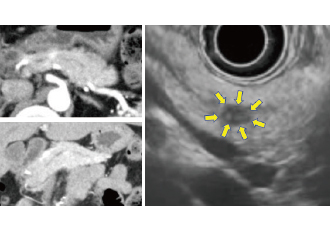
that CT/MRI cannot.
What is a medical oncologist?
Medical oncologists primarily manage “cancer drug therapy”(including chemotherapy, targeted therapy, and immunotherapy)among the various cancer treatments. In Western countries and other parts of the world, medical oncologists generally handle cancer drug therapy, but in Japan, there are still few specialists(1,399 nationwide as of May 2020), which is insufficient.
Chiba Prefecture has 66 specialists in cancer drug therapy, four of whom are affiliated with our hospital. Medical oncologists administer drug therapy and are involved in every stage of care, including diagnosis, testing, determining treatment plans, and evaluating treatment efficacy. They serve as coordinators of multidisciplinary cancer care teams.
We live in an era where one in two Japanese people will develop cancer. Medical oncologists are indispensable to creating a society where people can receive treatment and live with peace of mind, even after a cancer diagnosis.