- HOME
- Departments & Centers
- Plastic and Reconstructive Surgery
Plastic and Reconstructive Surgery
Target diseases of Plastic and Reconstructive Surgery

Do you know what conditions plastic surgeons treat?
Departments like ophthalmology and otolaryngology have specific organ references in their names. In contrast, the term “plastic” surgery lacks this specificity, making its scope less obvious.
"Plastic" means "to shape or reconstruct”. Plastic surgery is the specialty that restores lost function and appearance. We improve quality of life by making congenital deformities, as well as deformities or scars caused by injury or disease, less noticeable and more aesthetically pleasing. We also address concerns related to aging, such as ptosis (drooping eyelids) and facial spots.

Please review the following list of diseases we treat. You may be surprised to learn that plastic surgery addresses such a wide range of issues. Plastic surgery encompasses a vast array of conditions and treats deformities and defects that appear on the body's surface, literally from head to toe. If you are troubled by any of the conditions listed, please consult our outpatient service.
Our outpatient department features spacious procedure and laser treatment rooms. We perform minor surgeries, such as wound closure for injuries or removal of small benign skin tumors, as well as small-area laser treatments, on an outpatient basis.
In addition to inpatient surgeries, we also offer day surgery in our operating rooms.
Highlights of the department
1. We provide thorough explanations during consultations and select optimal treatments tailored to each patient's circumstances.
2. We offer a wide range of services, from basic treatments like wound suturing and benign skin tumor removal to advanced medical care and treatments.

Top left: Skin tumor on left cheek. Middle: Incision line drawn for tumor removal. Right: Post-surgery
Bottom left: One-month post-surgery. Middle: Four months post-surgery. Right: One-year post-surgery. Scar is barely noticeable
3. Our Scar Revision Center aims to create inconspicuous, aesthetically pleasing scars for all patients.
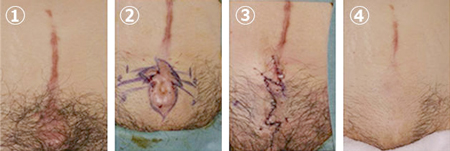
① Scar on the lower abdomen after surgery performed at another hospital's gynecology department. Since the scar was covered by clothing, the patient only requested treatment for the painful and itchy area within the pubic hair region.
② Surgery: Only the raised, red scar within the pubic hair region was excised.
③ To prevent recurrence, the incision was closed with zigzag sutures.
④ One-year post-surgery. The pain and itching observed before surgery have disappeared.
4. Our department provides multidisciplinary treatment for congenital anomalies, severe trauma, and reconstructive surgery for the head, neck, and breast. We also treat refractory ulcers, which are wounds that do not heal easily. To provide this treatment, we collaborate closely with other departments within our hospital.
Our department places great importance on communicating thoroughly with each patient before proceeding with treatment.
Scope of treatment
Our department provides treatment and surgery for the following conditions and diseases. Please consult us even if your condition/disease is not listed, as we may still be able to help.
- Congenital anomalies of the body surface, including cleft lip and palate, congenital ptosis, epiblepharon, microtia, other congenital auricular deformities, syndactyly, polydactyly, umbilical hernia, simple hemangioma (port-wine stain), nevus flammeus (café-au-lait spot), pigmented nevus (black mole), etc.
- Burns
- Facial trauma and facial bone fractures, including nasal bone fracture, zygomatic bone fracture, and orbital fracture
- Limb trauma
- Skin tumors, subcutaneous tumors, and soft tissue tumors, including skin cancer, benign skin tumors (such as moles and sebaceous cysts), hemangiomas, and lipomas
Reconstruction after cancer resection (e.g., head and neck cancer, breast cancer) - Hypertrophic scars/keloids (raised scars)
- Scar contracture (tightening due to scarring)
- Pressure ulcers (bedsores)
- Chronic ulcers (wounds that do not heal easily due to diabetes, trauma, lower limb
ischemia, etc.) - Other: Facial nerve paralysis, ptosis (drooping eyelid), entropion (inward turning of the eyelid), lymphedema, bromhidrosis (armpit odor), etc.
Laser treatment for skin spots, such as age spots and seborrheic keratoses, is an out-of-pocket service and not covered by national health insurance.
*For other out-of-pocket services, please inquire before your visit. Depending on the nature of your consultation, we may not be able to accommodate your request.
Areas of special focus
- Congenital disorders
- Facial bone fractures
- Obsolete (old or malunited) nasal bone fractures
- Facial skin tumor excision and post-excision reconstruction. Soft tissue tumor excision
- Breast reconstruction
- Inverted nipples/subareolar abscesses
- Refractory lower limb ulcers
- Age-related ptosis
- Lymphedema
- Facial nerve palsy
- Anophthalmic socket
Other specialty fields and unique treatments
Scar revision center
For individuals with prominent scars, we provide advanced, customized treatments combining medication, laser therapy, regenerative medicine (planned for a medical practice license in the future), surgery, and radiation therapy.
Laser therapy
We propose an optimal treatment plan combining laser therapy and surgery for congenital birthmarks (black, brown, or red-brown nevi). Depending on the condition, laser treatment for birthmarks may be covered by national health insurance. We also treat age-related pigmentation spots, such as "sunspots." However, this treatment is not covered by national health insurance and is an out-of-pocket expense.