- HOME
- Departments & Centers
- Gastroenterology
Gastroenterology
We treat diseases affecting organs such as the upper and lower gastrointestinal tracts, the liver, the biliary tract, and the pancreas. Together with the Department of Hepato-Biliary-Pancreatic and Gastrointestinal Surgery, we operate as the Gastroenterology Center to provide clinical care, conduct research, and offer education, all with the aim of enhancing patient convenience.
Highlights of the department
- We have specialists assigned to each specific condition. In particular, we have significantly increased the number of physicians, including surgeons, in the fields of liver, biliary, and pancreatic care, as patient numbers in these areas have risen sharply in recent years.
- Among malignant gastrointestinal tumors, gastric, colorectal, and liver cancers can be detected early through endoscopy and ultrasound examinations. In collaboration with the Center for Preventive Medicine, we promote early detection through health screenings.
- We collaborate with the Emergency Center to ensure that not only patients visiting our hospital but also those requiring urgent care, such as those with gastrointestinal bleeding, acute liver failure, acute pancreatitis, and other acute abdominal conditions, can be admitted from nearby facilities.
Liver transplantation
1. What is a liver transplant?
The liver is an essential organ responsible for detoxification, metabolism, storage, and bile production. When liver function becomes severely impaired due to congenital or acquired diseases, life can be at risk. Many liver diseases improve with medical treatment, but in cases where recovery is not possible, replacing the liver through transplantation becomes the only effective life saving option.
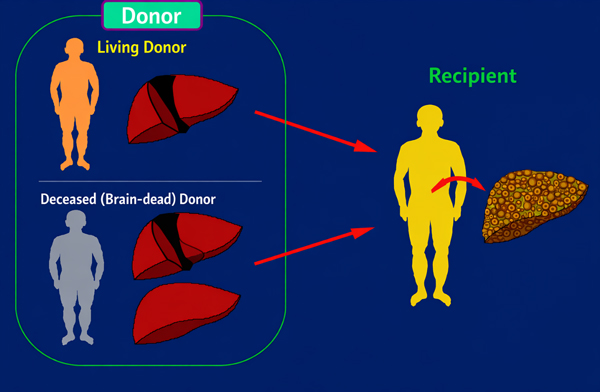
Artificial or animal-derived livers are not available, so a human donor is required. The donor is called the donor, and the patient receiving the liver is the recipient. Living-donor liver transplantation uses a portion of a relative’s liver, while deceased-donor transplantation uses a whole or partial liver from a brain-dead donor.
Although liver transplantation is not a treatment available to everyone, it can restore health in patients whose only life threatening problem is liver failure.
2. Indications for liver transplantation
Liver transplantation is performed for a wide range of diseases. In adults, the most common indications include severe decompensated cirrhosis caused by alcohol, non alcoholic steatohepatitis (NASH)/ Metabolic Dysfunction-Associated Steatohepatitis (MASH), autoimmune liver disease, or viral hepatitis. The website of the Japan Society of Hepatology lists many conditions for which patients have previously undergone liver transplantation (https://www.jsh.or.jp/medical/transplant/indications/ ). Severity is assessed using the Child–Pugh score, and patients with Child–Pugh C or advanced B are considered candidates.

Transplantation may also be performed for hepatocellular carcinoma (HCC) if liver function is poor and the tumor meets Japanese Criteria.
Japanese Criteria for hepatocellular carcinoma (HCC) refers to meeting either of the following two sets of criteria:
1. Milan criteria (international standard)
- For a single tumor: maximum diameter ≤ 5 cm
- For multiple tumors: maximum diameter ≤ 3 cm and number ≤ 3
- No extrahepatic metastasis
- No vascular invasion
- Cases not meeting these conditions are considered “absolute contraindications.”
- Adopted in 2004 as the insurance-based eligibility criteria for liver transplantation in Japan.
2. 5-5-500 Criteria (Japan’s original Criteria)
- Maximum tumor diameter ≤ 5 cm
- Number of tumors ≤ 5
- Serum alpha-fetoprotein (AFP) level ≤ 500 ng/mL
Intrahepatic cholangiocarcinoma and metastatic liver tumors are generally not eligible.
Age over 66 (especially 70), active malignancy outside the liver, severe infection, or significant heart/lung dysfunction may make transplantation unsuitable.
3.The conditions for living liver donors
The conditions for living liver donors are described on the website of the Japanese Liver Transplantation Society (http://jlts.umin.ac.jp/history/donor.html ). The key points are summarized below:
- Donors must be in completely good health. Although the definition of “good health” varies by institution, individuals with hypertension requiring medication or diabetes with abnormal laboratory values are generally considered ineligible.
- The donor must be a relative of the recipient (within six degrees of consanguinity or three degrees of affinity). Friends, former spouses after divorce, or partners who are only planning to marry are not permitted to become donors in Japan.
- The acceptable age range is 20 to 65 years. Livers from older donors are considered to have lower functional capacity compared with those from younger donors.
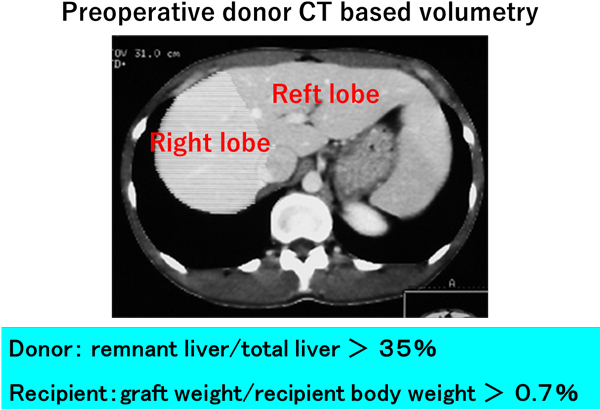
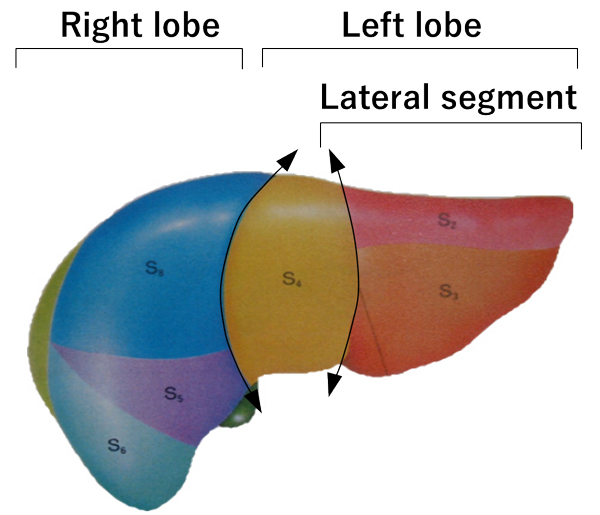
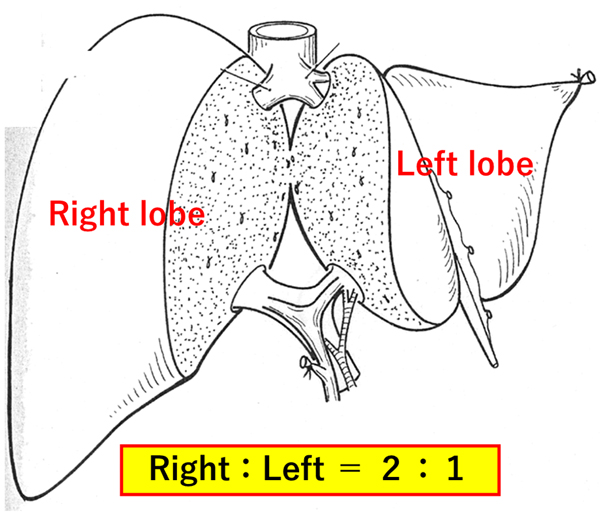
- Both the donor and the recipient must have sufficient liver volume. In adult-to-adult living donation, either the right lobe graft or the left lobe graft is used. Liver volume is calculated in detail using CT-based volumetry. The donor must retain at least 35% of their total liver volume after donation, and the recipient must receive a graft volume of at least 0.7% of their body weight. Even if the donor has a strong desire to donate, insufficient liver volume may result in ineligibility.
- Voluntary donor intent is essential. Donor candidates are always interviewed separately from the recipient. While saving the recipient’s life is a wonderful outcome, it is explained clearly that the donor—who is otherwise healthy—derives no physical benefit from the surgery.
4.Living donor liver transplantation (LDLT)
The recipient and donor surgeries are performed in adjacent operating rooms and begin almost simultaneously.
Donor surgery: In recent years, liver resections for liver cancer (non transplant surgery) are often performed laparoscopically. However, in living donor liver transplantation, only laparoscopic procurement of the lateral segment graft for pediatric recipients had been covered by insurance. In the spring of 2026, laparoscopic procurement of right lobe and left lobe grafts for adult recipients finally became eligible for insurance coverage, although specific operational guidelines had not been released as of April. For the latest details, please contact the transplant outpatient clinic. After donation of a right lobe or left lobe graft, the donor’s remnant liver regenerates over the following months. The typical hospital stay is around two weeks.
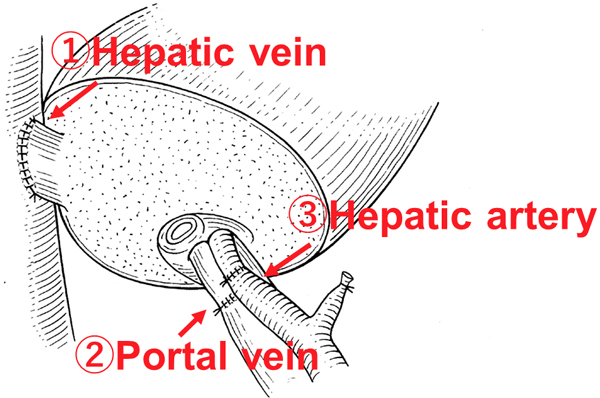
Recipient surgery: Recipient surgery is performed through a large open incision (laparoscopic transplantation is not covered by insurance). The diseased native liver is completely removed, and the donor liver is implanted. The hepatic veins (outflow), the portal vein and hepatic artery (inflow), and the bile duct (bile drainage) are reconstructed individually. The operation may take more than 10 hours. The hospital stay usually ranges from one to three months, but it can be significantly longer depending on the clinical course.
In Japan, the 1 year survival rate after living donor liver transplantation is approximately 83%, and the 5 year survival rate is approximately 75%.
5. Postoperative complications and outcomes
For donors, postoperative complications may include bile leakage and bile duct injury. Although the incidence is not high, any complication arising from a surgery performed for someone else must be regarded as highly significant, regardless of how rare it is. In Japan, more than 10,000 living liver donors have undergone surgery over the past 35 years, and there was one donor death approximately 20 years ago.
For recipients, a wide variety of postoperative complications may occur. Because recipients are already in poor condition due to underlying liver disease, undergo major surgery, and require postoperative immunosuppressive therapy, infections, rejection, and other potentially life threatening complications can occur. Postoperative management is carried out by an experienced transplant surgeon working closely with a multidisciplinary team.
6. Medical expenses
Living donor liver transplantation is covered by the national health insurance system. Each patient pays medical expenses using their own health insurance. Patients who undergo transplantation may also be eligible for social support programs such as the Medical Aid Program for the Severely Disabled. If medical expenses become high, the High Cost Medical Expense Benefit system limits the patient’s out of pocket payment. Hospital staff can explain these systems before transplantation.
Preoperative donor evaluation is paid out of pocket. Depending on the tests performed, the total cost is generally between 100,000 and 200,000 yen. If the individual proceeds to become an actual donor, the costs are recalculated as insured medical care after surgery, and any overpayment is refunded. However, if the donor does not proceed to donation due to donor related or recipient related reasons, the evaluation remains self pay. To minimize unnecessary costs, tests that are most likely to determine donor eligibility are usually performed first. After donation, all donor medical expenses are billed under the recipient’s account, and donors do not receive medical bills. Once several months have passed and the donor is stable, with follow up visits reduced to once every 6–12 months, the attending physician may switch donor medical billing back to the donor.
7. Liver transplant team at International University of Health and Welfare
IUHW Narita Hospital, which opened in the spring of 2020, has performed a large number of gastrointestinal and hepatobiliary surgeries. The hospital began full scale preparation for liver transplantation in fiscal year 2024 and will launch its liver transplant program in fiscal year 2025. Our hospital staff—including the departments of Gastrointestinal Surgery, Gastroenterology, Radiology, and Pathology—consists of many professionals with extensive experience in liver transplantation.
Patients wishing to receive consultation, as well as healthcare providers who wish to refer patients, are encouraged to contact us at the information below.
Contact information
International University of Health and Welfare, Narita Hospital
Regional Medical Liaison Office
TEL: +81-476 35 5601 FAX: +81-476 35 5588
Clinical indicators
April 2022 to March 2023
| FY 2022 | |
|---|---|
| Upper gastrointestinal endoscopy | 1,936(Health checkups: 5,097) |
| Lower gastrointestinal endoscopy | 1,783(Health checkups: 285) |
| Endoscopic polypectomy | 710 |
| Endoscopic mucosal resection | 135 |
| Endoscopic submucosal dissection | 87(Esophagus:4, Stomach:29, Colon:53) |
| Capsule endoscopy | 5 |
| Esophageal manometry | 3 |
| Endoscopic retrograde cholangiopancreatography(ERCP) | 217 |
| Endoscopic ultrasound(EUS) | 271 |
| Endoscopic ultrasound-guided fine-needle aspiration(EUS-FNA) | 75 (including drainage) |
| Treatment of esophageal varices(ligation/sclerotherapy) | 14 |
| Percutaneous radiofrequency ablation | 4 |
| Hepatic artery chemoembolization | 10 |
| Treatment of acute liver failure | 4 |