- HOME
- Departments & Centers
- Thoracic Surgery
Thoracic Surgery
We provide comprehensive care for a wide range of conditions, including malignant lung tumors(primarily lung cancer and metastatic lung tumors), mediastinal tumors, and malignant pleural mesothelioma, as well as benign conditions such as pneumothorax.
We prioritize safety and provide treatment tailored to each patient
We provide thorough information and explanations, select the treatment best suited to each patient, and prioritize safety in all aspects of our care.
We work closely with the Pulmonology Department to propose multifaceted treatment options
While our primary focus is surgical treatment, we also offer non-surgical options depending on the patient’s condition. We collaborate with the departments of Pulmonology and Radiology to evaluate treatment options from a multifaceted perspective.
Main target diseases
Lung cancer, metastatic lung tumors from various organs, mediastinal tumors, cystic lung diseases (such as pneumothorax), etc.
Highlights of the department
- 1. Surgical treatment
- Our department specializes in surgical treatment. We primarily treat lung cancer, metastatic lung tumors from other organs, thymic tumors, and malignant tumors, such as malignant pleural mesothelioma.
We collaborate with the Departments of Pulmonology and Radiology to develop personalized treatment plans for each patient. We provide patients with a thorough explanation of their condition and treatment options, ensuring they fully understand the process before proceeding.
- 2. Aiming for minimally invasive, organ-preserving, and curative treatment
- Regarding surgery, we prioritize safety above all else and strive to provide gentle, patient-centered treatment. We use thoracoscopic surgery to minimize incision size, reduce postoperative pain, and preserve respiratory muscles. Additionally, we actively perform reconstructive procedures on the bronchi and blood vessels to achieve curative outcomes.
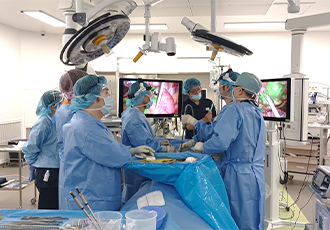
(right upper lobe S1 segmentectomy
+ lymph node dissection)
A thoracoscope(right)is inserted
through a small incision in the chest,
and the surgeon(left)performs the resection
while monitoring the procedure on a screen.
- 3. Perioperative rehabilitation
- By incorporating our hospital’s signature comprehensive rehabilitation program before and after surgery, we aim to facilitate early mobilization, reduce postoperative complications, enable early discharge, and improve postoperative quality of life(QOL).
- 4. Other specialty fields and unique treatments
-
Diagnosis using endobronchial ultrasound(EBUS)
We actively perform diagnoses of peripheral lesions(EBUS-GS)and mediastinal/hilar lymph nodes(EBUS-TBNA). By obtaining cells from even very small lesions, we can accurately assess the clinical stage of lung cancer and implement the appropriate treatment strategy.
Salvage surgeryWe consider surgical resection of residual tumors in cases of advanced lung cancer following treatment with molecularly targeted drugs or immune checkpoint inhibitors.
Malignant pleural mesotheliomaWe collaborate with the departments of Pulmonology and Radiology to tailor treatment based on the patient’s condition. Treatment options range from conventional trimodality therapy(chemotherapy, surgery, and radiation therapy)to the use of immune checkpoint inhibitors.
Myasthenia gravisIn collaboration with the Department of Neurology, we perform minimally invasive extended thymectomy for myasthenia gravis using thoracoscopy.
Functional restoration surgeryWe perform lung volume reduction surgery for emphysema and diaphragmatic plication for respiratory dysfunction caused by diaphragmatic hypotonia using thoracoscopy, applicable to a limited number of patients.
Early-stage lung cancer detection and resectionWe detect early-stage lung cancer cases—often referred to as “ground-glass opacities”—using CT scans and actively perform limited resection surgeries (such as segmentectomy) that preserve lung function, utilizing 3D reconstructed images. Given that lung cancer affects many elderly patients, this approach is expected to significantly extend healthy life expectancy.
Tracheal and bronchial interventionsIn collaboration with the Pulmonology Department, we perform procedures such as stent placement and laser therapy for airway lesions.
Surgical performance
※You can scroll horizontally to view more.
| 2020 | 2021 | 2022 | 2023 | 2024 | 2025 | |
|---|---|---|---|---|---|---|
| Number of general anesthesia cases | 85 | 161(9) | 180(14) | 184(17) | 234(31) | 234(44) |
| Lung cancer | 43 | 89 | 86(1) | 78(12) | 104(20) | 95(21) |
| (Residual)pneumonectomy | 0 | 0 | 0 | 0 | 0 | 0 |
| Lobectomy | 21 | 35 | 24(1) | 36(7) | 41(6) | 38(10) |
| Segmentectomy | 16 | 41 | 48 | 35(5) | 47(14) | 48(11) |
| Wedge resection | 3 | 10 | 13 | 4 | 12 | 7 |
| Other | 3 | 3 | 1 | 3 | 4 | 2 |
| Metastatic pulmonary tumor | 1 | 1 | 18 | 18 | 15(1) | 25(4) |
| Lobectomy | 0 | 0 | 3 | 2 | 2(1) | 3(1) |
| Segmentectomy | 0 | 1 | 3 | 6 | 4 | 10(3) |
| Wedge resection | 1 | 0 | 12 | 10 | 9 | 11 |
| Other | 0 | 0 | 0 | 0 | 0 | 1 |
| Mediastinal tumor | 12 | 19(9) | 19(13) | 18(5) | 24(10) | 28(19) |
| Thymic epithelial tumor | 6 | 4(1) | 8(7) | 3 | 11(5) | 12(10) |
| Other | 6 | 15(8) | 11(6) | 14(5) | 13(5) | 16(9) |
| Myasthenia gravis | 2 | 0 | 1 | 1 | 1(1) | 3(3) |
| Malignant pleural mesothelioma | 0 | 2 | 5 | 3 | 4 | 2 |
| Extrapleural pneumonectomy | 0 | 0 | 0 | 1 | 0 | 0 |
| Pleurectomy/decortication | 1 | 0 | ||||
| Biopsy | 0 | 2 | 5 | 2 | 3 | 2 |
| Cystic lung disease | 11 | 10 | 17 | 19 | 29 | 28 |
| Pneumothorax | 9 | 9 | 16 | 15 | 26 | 26 |
| Other | 2 | 1 | 1 | 4 | 3 | 2 |
| Thoracic empyema | 5 | 7 | 13 | 22 | 21 | 23 |
| Trauma surgery | 1 | 3 | 2 | 3 | 3 | 5 |
| Other | 13 | 30 | 22 | 23 | 34(1) | 36 |
Note: The numbers for each disease include surgeries performed simultaneously.
Note: The numbers in parentheses indicate robot-assisted surgeries.