- HOME
- Departments & Centers
- Renal and Urological Surgery
Renal and Urological Surgery
We provide surgical and medical treatment for urological diseases affecting the kidneys, ureters, bladder, and urethra in both men and women, as well as prostate, testicular, and epididymis diseases in men.
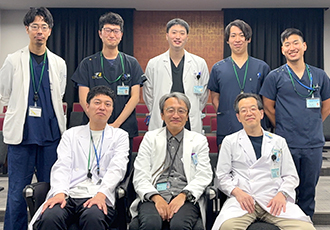
We prioritize quality of life by performing minimally invasive treatments
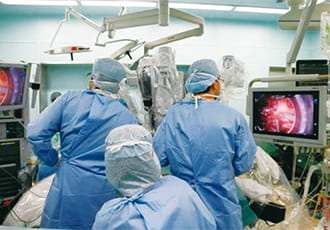
In addition to laparoscopic surgery, we perform minimally invasive procedures with state-of-the-art robotic surgical assistance to reduce the physical burden on patients. We consider organ-preserving therapies, even for conditions that are usually treated with radical resection.
We provide comprehensive care for a wide range of conditions.
We provide comprehensive care for a wide range of conditions, including genitourinary malignancies, benign urological tumors, neurogenic bladder, urinary incontinence, male infertility, andrology, male sexual dysfunction, adrenal disorders, urinary stone disease, and urinary tract infections.
Our team includes physicians who specialize in urological malignancies and their respective subspecialties, such as urinary stones, infections, voiding disorders, male sexual dysfunction, and kidney transplantation.
Main target diseases
General urology; urinary tract and male reproductive organ neoplastic diseases (e.g., kidney cancer, renal pelvis/ureter cancer, bladder cancer, prostate cancer, and testicular cancer); urinary tract stones; urinary tract infections; voiding disorders (e.g., difficulty urinating, frequent urination, and urinary incontinence, including benign prostatic hyperplasia and overactive bladder); sexual dysfunction; and male menopause.
Highlights of the department
- 1.Bladder-preserving therapy for bladder cancer
- We actively pursue treatments that preserve the bladder. Although radical cystectomy with urinary diversion is the standard treatment for muscle-invasive bladder cancer, it can sometimes result in a decline in the patient's quality of life (QOL) after surgery. Our department has extensive experience and actively recommends bladder-preserving therapies that help maintain quality of life.
- 2.Robot-assisted surgery for prostate cancer
- For early-stage prostate cancer, we primarily recommend a radical prostatectomy using the Da Vinci surgical robot or radiation therapy (IMRT). Active surveillance is also an option in appropriate cases. Beyond surgical treatment, we propose treatment plans based on guidelines that include hormone therapy, chemotherapy for recurrent cancer, and new hormonal therapies.
- 3.Treatment for benign prostatic hyperplasia (BPH)
- We initiate drug therapy first. If symptoms do not improve, we perform endoscopic surgery. An endoscope is inserted and the enlarged prostate tissue is removed using an electric knife (TURP) or a laser (prostate vaporization).
- 4.Kidney transplantation
- For patients on dialysis or with declining kidney function who will require dialysis in the future, our experienced physicians recommend kidney transplantation. If a family member is willing to donate a kidney, we propose living donor transplantation. For patients without a suitable family donor, we assist with registration with the Japan Organ Transplant Network for deceased donor kidney transplantation.
- 5.Female urology
-
Stress urinary incontinence(SUI)
Many patients experience urine leakage due to poor coordination between the pelvic floor muscles and abdominal pressure. Pelvic floor muscle exercises often lead to improvement.
For surgical cases, we perform urethral sling surgery, which requires a hospital stay of approximately three nights and four days. The procedure takes about 30 minutes.Pelvic organ prolapse (POP)
The pelvic organ structure of women differs from that of men in that it features a vaginal canal for childbirth. Prolapse (herniation) of various organs through this canal is called pelvic organ prolapse. A descending bladder is called a cystocele; a descending rectum, a rectocele; and a descending uterus, a uterine prolapse. We recommend active treatment for those with complete prolapse. We recommend laparoscopic sacrocolpopexy, a treatment in which the prolapsed portion is supported with mesh and fixed to the lower back ligaments.
- 6.Treatment of testicular tumors
-
Testicular tumors are rare cancers in young men, but our specialists have extensive experience with numerous cases. Our team has treated over 100 cases of metastatic testicular tumors and possesses one of the most extensive treatment records in Japan.
Retroperitoneal lymph node dissection is performed by highly experienced surgeons.
- 7.Extracorporeal shock wave lithotripsy for urinary tract stones
-
We offer both extracorporeal shock wave lithotripsy and endoscopic treatments for urinary tract stones.
Our department includes physicians with extensive experience in extracorporeal shock wave lithotripsy(ESWL). This technique uses shock waves applied externally to shatter stones into small fragments, eliminating the need for surgery or incisions. We actively treat cases that are difficult to manage at general hospitals.
The latest surgical robot: Da Vinci Xi
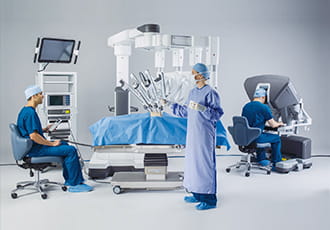
In April 2020, our hospital introduced the latest surgical robot system, the “Da Vinci Xi.”Da Vinci robotic surgery involves inserting multiple arms with surgical instruments and an endoscope through small incisions in the patient's abdomen. The surgeon operates these instruments from a control console while viewing images from the endoscope.
The Da Vinci system provides stereoscopic 3D images, allowing surgeons to zoom in on areas close to the surface. This magnified field of view enables more precise and detailed work than is possible with the naked eye.
Compared to conventional surgery, the Da Vinci system dramatically improves the capabilities, reliability, and functionality of minimally invasive procedures. For radical prostatectomy to treat prostate cancer, it minimizes postoperative urinary incontinence. In recent years, the Da Vinci system has also been adopted for partial nephrectomy for kidney cancer and radical cystectomy for bladder cancer.
Our hospital staff is equipped to handle any of these procedures.
Surgical performance
※Please scroll horizontally to view.
| 2020 Jan. - Dec. |
2021 Jan. - Dec. |
2022 Jan. - Dec. |
2023 Jan. - Dec. |
2024 Jan. - Dec. |
2025 Jan. - Dec. |
|
|---|---|---|---|---|---|---|
| Adrenal gland | ||||||
| Laparoscopic adrenalectomy | 3 | 10 | 9 | 2 | 2 | 6 |
| Kidney and ureter | ||||||
| Nephrectomy and nephroureterectomy | 10 | 13 | 17 | 22 | 24 | 27 |
| (laparoscopic surgeries) | 4 | 8 | 11 | 13 | 14 | 10 |
| (robot-assisted procedures) | 0 | 0 | 1 | 3 | 4 | 6 |
| Partial nephrectomy | 1 | 10 | 16 | 17 | 15 | 12 |
| (laparoscopic robot-assisted) | 0 | 10 | 16 | 16 | 15 | 12 |
| Pyeloplasty | 0 | 0 | 2 | 6 | 2 | 1 |
| (laparoscopic surgeries) | 0 | 0 | 2 | 6 | 0 | 0 |
| (robot-assisted procedures) | 0 | 0 | 1 | 5 | 2 | 1 |
| Extracorporeal shock wave lithotripsy(ESWL) | 16 | 34 | 52 | 49 | 25 | 15 |
| Transurethral urinary tract stone lithotripsy(TUL/fTUL) | 12 | 36 | 46 | 69 | 99 | 76 |
| Percutaneous nephrolithotomy | 0 | 3 | 0 | 2 | 1 | 10 |
| Percutaneous nephrostomy creation | 1 | 7 | 6 | 12 | 16 | 10 |
| Transurethral ureteral stent placement | 14 | 21 | 35 | 45 | 76 | 86 |
| Retroperitoneal malignant tumor resection | 0 | 1 | 1 | 2 | 0 | 1 |
| Kidney transplantation(living donor) | 1 | 2 | ||||
| Kidney donation transplant | 1 | |||||
| Kidney procurement for transplantation(living donor) | 1 | 2 | ||||
| Bladder | ||||||
| Radical cystectomy + urinary diversion | 0 | 3 | 6 | 10 | 15 | 16 |
| (laparoscopic robot-assisted) | 0 | 0 | 2 | 7 | 14 | 15 |
| (ileal conduit) | 0 | 1 | 2 | 6 | 12 | 15 |
| (ileal neobladder) | 0 | 2 | 0 | 1 | 1 | 0 |
| Partial cystectomy | 0 | 2 | 1 | 1 | 3 | 0 |
| Transurethral resection of bladder tumor(TUR-Bt) | 11 | 50 | 65 | 58 | 57 | 74 |
| Cystolithotomy | 0 | 0 | 1 | 1 | 1 | 9 |
| Prostate | ||||||
| Prostate biopsy | 30 | 59 | 109 | 160 | 181 | 154 |
| Radical prostatectomy | 25 | 36 | 79 | 72 | 62 | 53 |
| (laparoscopic robot-assisted) | 25 | 36 | 79 | 72 | 62 | 53 |
| Transurethral resection of the prostate(TUR-P) | 1 | 1 | 0 | 1 | 0 | 1 |
| Transurethral laser prostate ablation(Thu-VAP) | 15 | 21 | 16 | 28 | 33 | 34 |
| Space OAR placement | 0 | 0 | 14 | 27 | 25 | 14 |
| Urethra and penis | ||||||
| Penile malignant tumor surgery(resection/partial resection) | 2 | 0 | 1 | 1 | 2 | 0 |
| Endoscopic surgery for urethral stricture | 0 | 4 | 1 | 1 | 5 | 10 |
| Circumferential resection | 0 | 2 | 1 | 4 | 1 | 8 |
| Peyronie's disease surgery | 0 | 0 | 0 | 1 | 1 | 0 |
| Testes and scrotum | ||||||
| Radical orchiectomy | 0 | 4 | 8 | 8 | 5 | 7 |
| Retroperitoneal lymph node dissection(for testicular tumor) | 0 | 7 | 4 | 2 | 2 | 2 |
| Orchiectomy | 1 | 1 | 3 | 4 | 2 | 6 |
| Spermatic cord torsion surgery | 0 | 3 | 1 | 1 | 0 | 4 |
| Hydrocelectomy | 0 | 4 | 6 | 3 | 2 | 6 |
| Microscopic varicocelectomy | 1 | 0 | 2 | 2 | 2 | 1 |
| Undescended testis surgery(orchiopexy) | 0 | 0 | 1 | 0 | 0 | 14 |
| Female urology | ||||||
| Urinary incontinence surgery | 0 | 1 | 5 | 4 | 7 | 5 |
| Sacrocolpopexy | 0 | 3 | 7 | 23 | 17 | 23 |
| (laparoscopic surgeries) | 0 | 3 | 7 | 21 | 17 | 23 |
| (robot-assisted procedures) | 0 | 0 | 7 | 21 | 17 | 23 |
| Other | 5 | 12 | 28 | 30 | 37 | 34 |
| Total number of surgeries including others | 176 | 396 | 543 | 689 | 722 | 724 |
Other specialty fields and unique treatments
Lower urinary tract symptoms, urinary dysfunction, neurogenic bladder, and urinary tract infections.
[Special Notes]
- * Priority is given to patients with appointments or referrals. If you wish to visit without an appointment, we recommend calling ahead to inquire.
- * The attending physician may change or suspend their practice. Please call for more information.