- HOME
- Departments & Centers
- Emergency Medicine
Emergency Medicine
We contribute to regional emergency care by transporting and treating patients with a wide range of conditions, from mild to severe.
- We provide medical care at any time to all patients seeking treatment, regardless of the severity of their condition.
- Every patient visiting the Emergency Medicine undergoes prompt triage.
- The necessity for hospitalization is assessed, and patients are referred to the appropriate specialists or medical staff according to their treatment plan and condition.
- Emergency treatment is provided to patients experiencing a sudden in their clinical condition in all hospital departments.
- In cooperation with the Regional Medical Coordination Office, we serve as the contact point for referrals and patient transfers from local community institutions.
- We strengthen our ties with the regional emergency medical system through educational activities for emergency services and paramedics.
- We establish and continuously update emergency protocols, i.e., the standards for emergency medical activities at the scene.
- We contribute to regional healthcare through clinical research.
Highlights of the department
- 1. The “North American ER system”
-
The term “ER” stands for “emergency room”. While tertiary emergency centers have traditionally been the focus of advanced emergency care in Japan, the ER model of emergency medicine has attracted growing attention. The term “ER” is increasingly used to refer to this ER-style system of emergency care.
The true ER system originates from the North American model and has the following characteristics:- All emergency patients are treated in the ER, regardless of severity, type of illness or injury, or age.
- Emergency physicians provide care for all types of emergency cases.
- Emergency physicians are responsible for the management and operation of the ER.
- When trainee physicians on duty provide emergency care, they are supervised and guided by dedicated ER physicians who are always present in the ER.
- 2. A “reliable ER” contributing to the community
-
Our team of ten members—including five full-time emergency physicians, dedicated specialized nurses, and emergency medical technicians— contributes to regional emergency care. We provide emergency department care for patients transported by ambulance, as well as inpatient treatment in specialized fields of emergency medicine, such as sepsis, trauma, resuscitation, and poisoning.
- 3. Facilities, equipment, technology, and capacity to accept patients with any symptom
-
Our department can treat up to four critically ill patients simultaneously. We collaborate with other departments in the hospital to provide after-hours care space and have established a system that allows us to handle both walk-in and ambulance-transported patients smoothly.
Dedicated elevators are installed for critically ill patients to ensure immediate transport to the intensive care unit, operating rooms, or catheterization labs.
Our department provides comprehensive, team-based care using advanced medical equipment in collaboration with various hospital professionals.
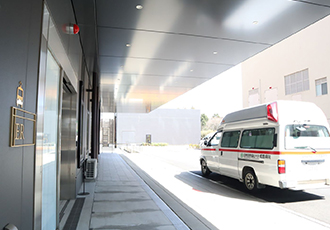
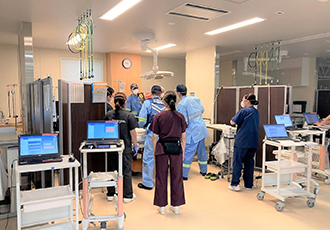
Primary areas managed by the Emergency Medicine
- Sepsis
-
Sepsis is a severe infection that causes organ dysfunction due to bacterial or other pathogens.
Treatment involves rapidly identifying the causative bacteria, administering antibiotics early, managing systemic circulation (including blood pressure and pulse), and providing mechanical ventilation when necessary.
The Emergency Medicine and the Intensive Care Unit teams work closely together in managing sepsis.
- Trauma
-
Major trauma can result from traffic accidents, falls, or other causes.
Rapid diagnosis and treatment by a team let by emergency physicians significantly impact survival and long-term functional outcomes. In cases of multiple injuries (chest, head, abdomen, limbs), we work closely with various surgical departments, including Orthopedics, Neurosurgery, Thoracic Surgery, and Hepato-Bilary-Pancreatic and Gastrointestinal Surgery, to advance the patient’s treatment.
- Resuscitation
-
Emergency physicians specialize in providing rapid initial care and intensive care management to critically ill patients facing life-threatening conditions, such as cardiac arrest, shock, seizures, and respiratory distress. Our emergency team provides swift treatment and collaborates with the intensive care unit team to deliver team-based care for the purpose of saving patients' lives.
- Poisoning
-
Poisoning cases such as medication overdose or gas inhalation fall within the field of emergency medicine. Under the leadership of physicians trained in medical toxicology in the United States, we standardize treatment protocols and provide both initial care and intensive management for poisoning cases.