- HOME
- Departments & Centers
- Cardiology
Cardiology
We provide specialized care for all types of cardiovascular diseases, including ischemic heart disease (such as angina pectoris and myocardial infarction), valvular heart disease, arrhythmias, heart failure, and adult congenital heart disease in close coordination with the Cardiac surgery and Vascular surgery departments.
Aiming for early detection and treatment
We address all risk factors for cardiovascular disease, including hypertension, dyslipidemia, metabolic syndrome, chronic kidney disease, and diabetes for early detection and their treatment. If you have risk factors or experience symptoms such as chest or back pain, palpitations, or shortness of breath, we recommend seeking prompt medical attention.
We offer a wide range of diagnostic tests and treatments
We perform examinations and diagnoses using echocardiography, exercise stress cardiography, myocardial scintigraphy, and coronary CT angiography. We promptly respond to various cardiovascular diseases with drug therapies, catheter-based coronary angioplasty, arrhythmia ablation, and the implantation of pacemakers, implantable cardioverter defibrillators (ICDs), and cardiac resynchronization therapy (CRT) devices.
Advanced medical practices by specialists
Under the guidance of our experienced specialists, we safely provide advanced medical care—a strength of our university hospital—for complex conditions such as structural heart disease, adult congenital heart disease, and pulmonary hypertension.
Main target diseases
Cardiovascular diseases including angina pectoris, myocardial infarction, arrhythmias, and heart failure (cardiac amyloidosis and cardiac sarcoidosis), as well as Fabry disease and mitochondrial encephalomyopathy; and arterial diseases including aortic aneurysm, aortic dissection, and obstructive atherosclerosis, as well as hypertension, dyslipidemia, metabolic syndrome, chronic kidney disease, diabetes.
Highlights of the department
- 1.Specialized outpatient clinic for ischemic heart disease (physician-in-charge: Dr. FUKUOKA Ryoma, Thursday morning)
-
Emergency cardiac catheterization treatment (acute coronary syndrome) is available 24 hours a day, 365 days a year. Patients who have completed acute treatment through the angina pectoris outpatient clinic (physician-in-charge: Dr. FUKUOKA, Thursday mornings) are referred back to their primary care physician.
- 2.Specialized outpatient clinic for cardiac amyloidosis (physician-in-charge: Dr. KAWAMURA Akio, Tuesday morning, Thursday afternoon, Friday morning)
-
Since 2023, we have been certified by the Japanese Circulation Society as a facility authorized to administer the cardiac amyloidosis treatment drug Vyndaqel. Please feel free to contact us for inquiries regarding initial administration.
- 3.Pulmonary hypertension clinic, balloon pulmonary angioplasty (physician-in-charge: SUGIMURA Koichiro, Tuesday morning, Thursday morning)
-
Since our establishment, we have collaborated with departments of Pulmonology and Allergy & Rheumatology to provide numerous patients with medical treatments as well as advanced procedures such as pulmonary artery balloon angioplasty. Approximately 30 balloon pulmonary angioplasty procedures are performed annually.
- 4.We perform safe and minimally invasive catheter-based treatments Arrhythmia: Ablation, pacemakers/implantable cardioverter-defibrillators (ICD)
-
Experienced physicians perform catheter ablation using high-frequency electricity for the treatment of tachyarrhythmias, as well as pacemaker implantation for bradyarrhythmias, implantable cardioverter-defibrillators (ICD) to prevent sudden cardiac death, and cardiac resynchronization therapy (CRT) device implantation.
Structural Heart Diseases
We plan to begin catheter treatment for valvular heart disease (TAVI) and patent foramen ovale (PFO) in 2024.
- 5.Other Specialized Fields and Specialized Medical Care
| Expertise and Specialties | Physician-in-charge |
|---|---|
| PTMC (Percutaneous transseptal mitral commissurotomy) for rheumatic mitral stenosis | KAWAMURA Akio |
| PTSMA (Percutaneous transluminal septal myocardial ablation) for Obstructive hypertrophic cardiomyopathy | FUJIMOTO Yoshihide |
| Catheter treatment for patent ductus arteriosus | KAWAMURA Akio |
| Percutaneous balloon pericardiotomy | FUKUOKA Ryoma |
| Spinal cord stimulation | SATO Takao |
Examinations and Diagnosis
By integrating findings from echocardiography, myocardial scintigraphy, coronary CT, and cardiac catheterization, we provide higher diagnostic accuracy and safe and reliable treatment strategies.
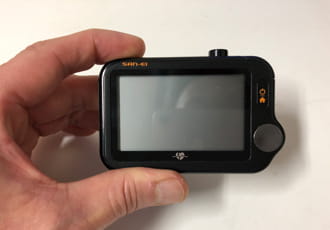
Portable ECG
Accurately diagnoses arrhythmia episodes of unknown cause and nocturnal angina attacks. Since an ECG can be recorded outside of a hospital or while out and about, diagnostic accuracy improves, providing the reassurance of always having a specialist nearby. It is available for loan for a certain period at the outpatient clinic.
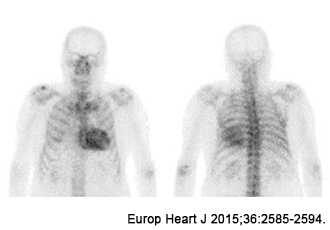
Myocardial scintigraphy
This test allows us to assess blood flow to the heart muscle, the extent of myocardial necrosis, and cardiac function. By examining changes in blood flow during exercise or other stress tests, we can obtain information about angina and areas of insufficient blood flow.
Pyrophosphoric myocardial scintigraphy is highly accurate and frequently used for the diagnosis of cardiac amyloidosis.
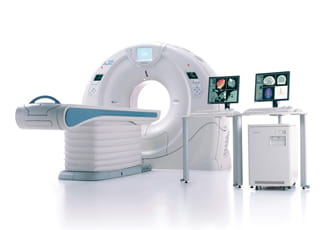
Coronary CT (320-slice)
This CT scanner can take 320 cross-sectional images in a single rotation. It enables highly accurate diagnosis in a very short time. Compared to conventional 64-slice CT scanners, it significantly reduces radiation exposure and contrast agent usage, further alleviating the burden on patients.
Cardiac catheterization
By selectively inserting a catheter into the coronary artery and injecting contrast agent, detailed information about coronary artery stenosis can be obtained. This is also useful for assessing the severity of conditions such as heart failure and valvular disease. If severe stenosis is detected in the coronary artery and is causing angina or other conditions, coronary angioplasty (PCI) can be performed using a catheter to implant a stent.
Clinical indicators
A. Trends since opening
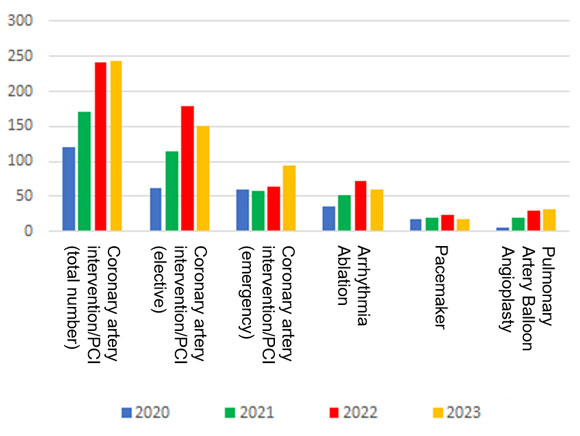
B. Breakdown
| 2020 | 2021 | 2022 | 2023 | |
|---|---|---|---|---|
| Coronary artery intervention/PCI (total number) | 120 | 171 | 241 | 244 |
| Coronary artery intervention/PCI (elective) | 61 | 114 | 178 | 150 |
| Coronary artery intervention/PCI (emergency) | 59 | 57 | 63 | 94 |
| Rotablator | 0 | 9 | 2 | 8 |
| Diamondback | 0 | 1 | 16 | 10 |
| Arrhythmia Ablation | 35 | 52 | 71 | 60 |
| Pacemaker | 18 | 20 | 23 | 18 |
| Implantable Cardioverter Defibrillator (ICD) / Cardiac Resynchronization Therapy (CRT) | 2 | 5 | 6 | 5 |
| Pulmonary Artery Balloon Angioplasty | 5 | 19 | 30 | 32 |
| Intra-aortic balloon pumping/IABP | 4 | 8 | 12 | 3 |
| Percutaneous cardiopulmonary support/PCPS | 2 | 3 | 5 | 1 |
| Myocardial biopsy | 31 | 44 | 24 | 25 |
| IVC filter placement | 3 | 6 | 0 | 0 |
| Percutaneous transseptal myocardial ablation/PTSMA | 1 | 0 | 0 | 1 |
| Percutaneous mitral valve commissurotomy (PTMC) | 0 | 1 | 0 | 0 |
| Patent ductus arteriosus (PDA) catheter closure | 0 | 1 | 0 | 1 |