- HOME
- Departments & Centers
- Breast Surgery
Breast Surgery
We specialize in diagnosing and treating breast diseases, primarily breast cancer. Our board-certified breast surgeons have extensive experience in breast cancer care and provide reliable medical care from diagnosis and treatment to post-operative follow-up.
We prioritize aesthetics
In breast cancer surgery, we ensure the complete removal of the tumor while giving full consideration to the aesthetic appearance of the breast.
We prioritize breast-conserving surgery
For small tumors, we typically perform breast-conserving surgery.
For larger tumors, we use preoperative treatment to shrink the tumor before performing breast-conserving surgery. If breast-conserving surgery is not possible and a mastectomy is necessary, we collaborate with the Department of Plastic Surgery to perform breast reconstruction surgery to restore the breast.
We provide thorough postoperative follow-up in collaboration with the local community
For breast cancer, we perform surgery, radiation therapy, and drug therapy(chemotherapy, hormone therapy, targeted therapy, etc.)tailored to the specific characteristics of the cancer. After surgery or upon completion of intensive treatments such as radiation or chemotherapy, we conduct thorough follow-up examinations every few months. We provide careful follow-up in collaboration with local partner facilities, taking into account the patient’s schedule and other needs.
Main target diseases
Breast cancer, fibroadenomas, mastopathy, etc.
Highlights of the department
- 1. Personalized treatment: treatment methods vary depending on the characteristics and stage of the cancer
- We perform a histological examination of the tumor to confirm the diagnosis of breast cancer and to determine its characteristics(such as hormone receptor status, HER2 expression, and proliferative capacity). Based on the stage and extent of the disease, we combine various treatment modalities—including surgery, radiation therapy, endocrine therapy, and chemotherapy—to strive for the best possible outcome.
- 2. Determining the surgical approach: total mastectomy or partial resection
-
Standard surgical options include total mastectomy and partial resection(breast-conserving surgery). While there is no difference in survival rates, breast-conserving surgery typically involves administering radiation therapy to the remaining breast.
The decision is made by comprehensively evaluating the tumor size, extent of spread to surrounding tissues, presence of multiple lesions, degree of intraductal spread, cosmetic outcome of the remaining breast if preserved, feasibility of postoperative radiation therapy, and the patient’s preferences.
When performing a total mastectomy, we offer procedures to preserve the nipple and perform breast reconstruction using autologous tissue or an implant in collaboration with a plastic surgeon.
- 3. Complication prevention: sentinel lymph node biopsy
-
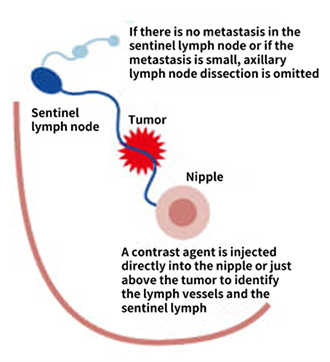
We examine the axillary(underarm)lymph nodes during surgery; if no metastasis is found, we do not perform further lymph node dissection. By omitting lymph node dissection, we significantly reduce the occurrence of complications such as impaired upper limb movement, swelling, and numbness.
-
A small amount of a radioactive isotope(a substance that emits a tiny amount of radiation)and a dye are injected into the areola or directly above the tumor
-
The radioactive isotope and dye travel through the lymphatic vessels and accumulate in the sentinel lymph node
-
The lymph node(sentinel lymph node)that shows up on the scan or is stained by the dye is removed
-
Rapid pathological examination is performed to determine whether there is metastasis in the sentinel lymph nodes
-
If the pathological examination shows no metastasis in the sentinel lymph nodes, or if there is only micrometastasis, lymph node dissection is omitted
-
Complications such as arm swelling, postoperative lymph fluid accumulation in the armpit, and abnormal sensation in the armpit are virtually eliminated
-
Breast reconstruction
We reconstruct the breast lost during surgery in collaboration with the Plastic Surgery department. We propose the optimal breast reconstruction method after considering the stage of breast cancer, the presence or absence of lymph node metastasis, the extent of mastectomy, and the size of the contralateral breast. Breast reconstruction is broadly categorized as follows based on the timing(immediate or delayed reconstruction)and the method used(autologous tissue or implant):
Immediate reconstruction:a method performed simultaneously with breast cancer surgery
Delayed reconstruction:a method performed after a certain period following breast cancer surgery
Breast reconstruction using autologous tissue:a method using tissue from the patient’s own abdomen or back(autologous tissue)
Breast reconstruction using implants:a method using a tissue expander and a breast implant(silicone implant)
Primary stage 1 reconstruction:a method in which reconstruction is performed simultaneously with breast cancer surgery using autologous tissue or an artificial breast
Primary stage 2 reconstruction:a method in which a tissue expander is inserted during breast cancer surgery (total mastectomy) to expand the skin, followed by reconstruction using autologous tissue or an artificial breast
Secondary stage 1 reconstruction:a method in which breast reconstruction using autologous tissue is performed after breast cancer surgery is completed and postoperative treatment has reached a milestone
Secondary stage 2 reconstruction:A method in which, after breast cancer surgery is completed and postoperative treatment has reached a conclusion, a skin expander is inserted to expand the skin, followed by reconstruction using autologous tissue or an implant
The most suitable method varies for each individual patient. Please consult thoroughly with a breast surgeon or plastic surgeon before breast cancer surgery to discuss your treatment plan for both breast cancer and breast reconstruction.
Surgical performance
| 2020 | 2021 | 2022 | |
|---|---|---|---|
| Surgery for malignant breast tumor | 56 | 134 | 130 |
| Breast-conserving surgery(partial mastectomy) | 27 | 78 | 75 |
| Total mastectomy | 29 | 56 | 55 |
| Surgery for benign disease | 3 | 12 | 16 |
| Total | 59 | 146 | 146 |