- HOME
- Departments & Centers
- Nephrology
Nephrology
We provide consistent management of all stages of kidney disease, from early treatment to dialysis care for end-stage renal failure.
High-level diagnosis and treatment
We accurately diagnose kidney pathologies such as acute kidney injury and chronic glomerulonephritis, as well as other chronic kidney diseases. We provide evidence-based treatments tailored to each patient.
For acute and chronic renal failure, we perform all forms of blood purification therapy, including hemodialysis, using advanced technical expertise.
We strive to provide comfortable dialysis, especially for elderly patients, and we offer dialysis care that supports patients and their families.
Thorough explanations for therapy selection
For patients requiring renal replacement therapy, such as hemodialysis, peritoneal dialysis, or kidney transplantation, we thoroughly explain each option.
We supplement these explanations with models and arrange for you to observe actual treatments in the dialysis room. In collaboration with the Renal and Urological Surgery Department, we have established a system for performing living donor kidney transplants, in which a family member donates a kidney. If you are interested in peritoneal dialysis, kidney transplantation, or would like a detailed explanation, please consult our "Renal Replacement Therapy Selection Clinic" held every Tuesday afternoon.
Cooperative framework that enables a prompt response
We provide high-quality medical care by consistently performing procedures such as internal shunt creation, peritoneal dialysis catheter placement, and internal shunt percutaneous transluminal angioplasty (PTA) in collaboration with surgical departments. This ensures accurate diagnoses and treatments without missing critical timeframes.
Main target diseases
Primary glomerulonephritis and secondary kidney diseases due to diabetes, hypertension, collagen diseases, etc. ; hereditary kidney diseases, including polycystic kidney disease; acute kidney injury; interstitial nephritis; and other kidney diseases. We also provide dialysis therapy for acute and chronic renal failure and its complications.
Highlights of the department
Our 986-square-meter hemodialysis center is located on the second floor of the hospital building. We plan to gradually increase the number of dialysis machines to 50. We strive to provide treatment in a comfortable environment.
- 1.Comfortable treatment environment
-
Patients receive treatment in spacious dialysis rooms. Each bed is equipped with an arm-mounted LCD TV and other amenities to ensure a comfortable experience.
- 2.Maintenance system and collaboration with local community facilities
-
We accurately diagnose kidney pathologies and prioritize evidence-based treatments to prevent the deterioration of kidney function and progression to the dialysis stage. For patients requiring dialysis or a kidney transplant, we support their treatment decisions by discussing optimal therapies with them and their families.
Furthermore, we have established a support system that collaborates with local community facilities to achieve meticulous and efficient management of kidney disease.
- 3.Hemodialysis
-
Our dialysis machines feature an advanced information and communication system called FutureNet. They automatically record critical dialysis data and vital signs, such as blood pressure, in real time to the electronic medical record. This enables rapid, accurate, and efficient information sharing among dialysis staff. The integration of this cutting-edge equipment with the cohesive teamwork of our experienced staff achieves a new level of team-based medical care, providing comfortable dialysis therapy.
- 4.Continuous Ambulatory Peritoneal Dialysis (CAPD) treatment rooms
-
Our dedicated CAPD rooms are equipped with advanced facilities for efficient and hygienic CAPD treatment. See the column below for details. Each room has a high-precision ultrasound device for immediately diagnosing catheter infections. In collaboration with specialized nurses and clinical engineers, we provide high-level, globally competitive, team-based medicine, namely "Team-Supported Peritoneal Dialysis".
Peritoneal dialysis
- 1.What is peritoneal dialysis?
-
Peritoneal dialysis (PD), a form of home dialysis, is currently being reevaluated as a treatment with many advantages, particularly for preserving residual kidney function. For patients in their prime working years, it minimizes physical constraints and supports economic activity. For elderly dialysis patients in our super-aged society, it offers numerous benefits, including reduced blood pressure fluctuations and a lighter physical burden from clinic visits.
Our department's team includes experienced physicians, nurses, and clinical engineers who actively participate in CAPD care and provide robust technical support.
- 2.Practicing CAPD team care at an extraordinary level
-
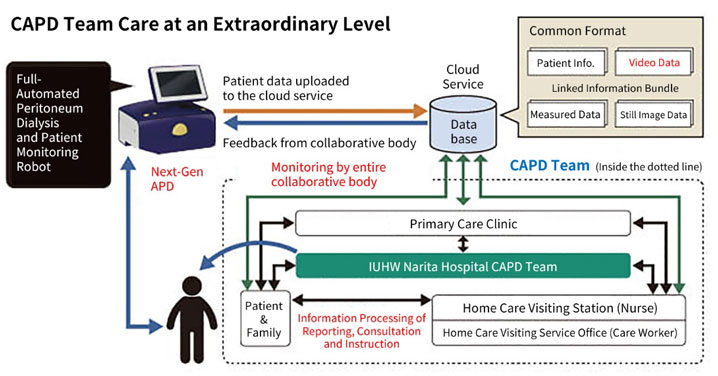
Our department utilizes highly advanced automated peritoneal dialysis (APD) machines to support home treatment through a team involving patients and their families. Treatment status and fluid removal data are automatically recorded in the cloud service and can be shared regardless of location or time. This enables a level of team-based care that surpasses conventional approaches.
Treatment data is transmitted from next-generation CAPD devices to the cloud system and stored there. The CAPD team within the dotted frame in the diagram shares this data and responds promptly as needed. For instance, if staff detect that a patient is feeling unwell, they contact the CAPD team at our hospital (the central hub). Then, home care visiting stations nearby or our hospital's visiting service team can respond quickly.
Based on data accumulated in the cloud, we also create educational materials for patients, families, and medical staff. These materials support self-management and provide guidance to help maximize our support in achieving high-quality self-management.