- HOME
- Departments & Centers
- Pediatrics
- Pediatrics: Neonatal Intensive Care Team
Pediatrics: Neonatal Intensive Care Team
Notice to patients
Effective April 1, 2026, Chiba Prefecture will designate IUHW Narita Hospital as a “Regional Perinatal, Maternal, and Child Healthcare Center.”
As a result, we will strengthen our collaboration with nearby medical institutions to provide advanced perinatal care.
In April 2026, the Neonatal Intensive Care Team at IUHW Narita Hospital will launch as a "Regional Perinatal Maternal and Child Healthcare Center."
Our center will provide 24-hour emergency care for mothers and newborns, serving as a key hub for perinatal care in the Narita and Inba areas.
Since strengthening our obstetrics and gynecology departments in October 2022, our hospital has steadily increased the number of births. Consequently, the demand for treatment by pediatricians, particularly for respiratory disorders, has also risen. Against this backdrop, our hospital's Department of Pediatrics established a new section called the Neonatal Intensive Care Team in April 2024. Since then, our clinical capabilities have improved further, and as the range of treatable conditions and treatment options has expanded, we have built a strong track record of patient care. Recently, collaboration between the Pediatrics and Pediatric Surgery departments has become even closer.
We have opened a new Neonatal Intensive Care Unit(NICU)for babies requiring intensive care, such as those born prematurely
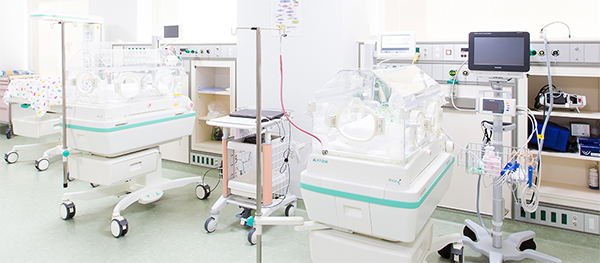
Since our hospital opened in 2020, the number of births has increased. To enhance medical care for newborns, we have opened a new Neonatal Intensive Care Unit(NICU).
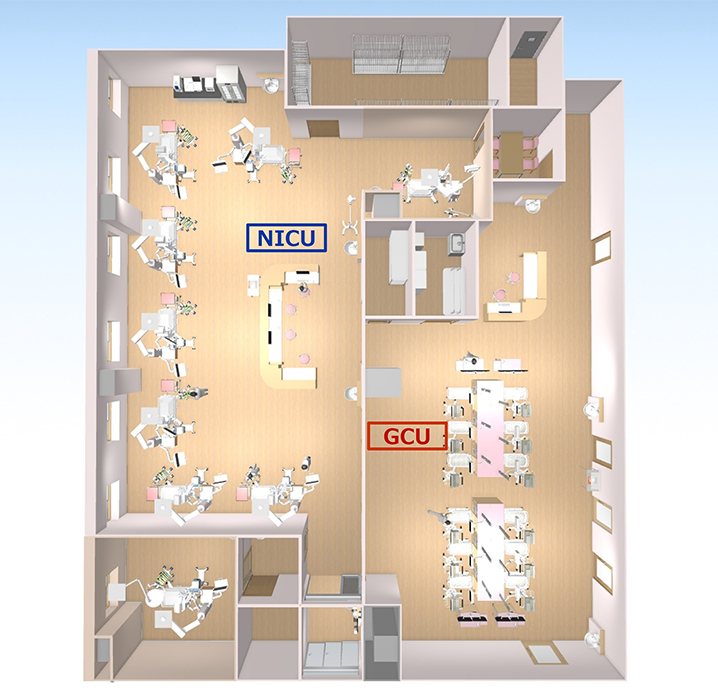
To provide comprehensive medical care for newborns (babies under 28 days old, from birth until around their one-month checkup), our hospital has established a team with the name of “Neonatal Intensive Care” focused on postnatal care and launched a new NICU.(The GCU(Neonatal Recovery Unit)is currently under preparation)
- NICU: An intensive care unit specialized for newborns, admitting premature infants, low birth weight infants, and infants with congenital conditions.
- GCU: A unit primarily for infants who have recovered after treatment in the NICU, where preparations for discharge are made.
It is generally estimated that approximately 15% of full-term babies born between 37 and 41 weeks of gestation require some form of support after birth, and about 5% require more advanced support. Furthermore, even when born healthy, babies born before full term (5–6% of all births) or with low birth weight(9–10% of all births)often require support to address their immaturity.
To improve medical care for these newborns, our hospital recruited two neonatologists with extensive NICU experience: Professor KASHMA Kohei, physician-in-chief of the Neonatal Intensive Care Team, and Lecturer KITASE Yuma. We have established a system capable of providing comprehensive care for premature babies, low-birth-weight infants, twins, and babies born to mothers with complications. In collaboration with our Pediatric Surgery department, we also aim to provide surgical care focused on the infant’s digestive tract.
Moving forward, the Obstetrics, Pediatrics, and Pediatric Surgery departments will collaborate to ensure that mothers can approach childbirth with peace of mind and contribute to regional healthcare in the areas of perinatal and pediatric medicine.

Clinical indicators
Trends in total neonatal admissions
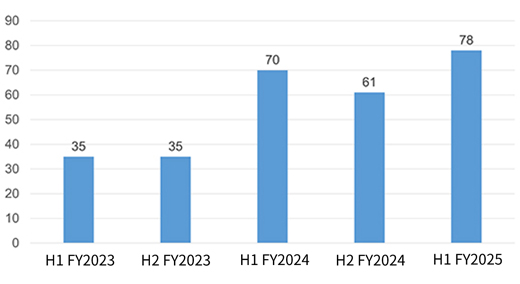
Trends in total neonatal admissions(by birth weights)
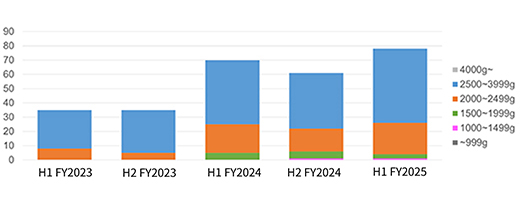
※You can scroll horizontally to view more.
| First half of FY 2023 |
Second half of FY 2023 |
First half of FY 2024 |
Second half of FY 2024 |
First half of FY 2025 |
|
|---|---|---|---|---|---|
| ~999g | 0 | 0 | 0 | 0 | 0 |
| 1000~1499g | 0 | 0 | 0 | 1 | 1 |
| 1500~1999g | 0 | 0 | 5 | 5 | 3 |
| 2000~2499g | 8 | 5 | 20 | 16 | 22 |
| 2500~3999g | 27 | 30 | 45 | 39 | 52 |
| 4000g~ | 0 | 0 | 0 | 0 | 0 |
| Total number | 35 | 35 | 70 | 61 | 78 |
Trends in newborn hospitalizations(by gestational age)
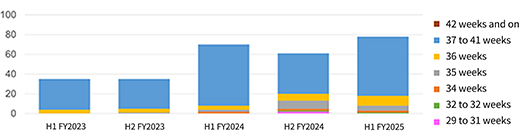
※You can scroll horizontally to view more.
| First half of FY 2023 |
Second half of FY 2023 |
First half of FY 2024 |
Second half of FY 2024 |
First half of FY 2025 |
|
|---|---|---|---|---|---|
| ~28 weeks | 0 | 0 | 0 | 0 | 0 |
| 29~31 weeks | 0 | 0 | 0 | 2 | 0 |
| 32~33 weeks | 0 | 0 | 0 | 1 | 1 |
| 34 weeks | 0 | 0 | 2 | 2 | 2 |
| 35 weeks | 0 | 1 | 2 | 8 | 5 |
| 36 weeks | 4 | 4 | 4 | 7 | 10 |
| 37~41 weeks | 31 | 30 | 62 | 41 | 60 |
| 42 weeks and beyond | 0 | 0 | 0 | 0 | 0 |
| Total number | 35 | 35 | 70 | 61 | 78 |
Trends in mechanical ventilation(counting the highest value without duplication)
※You can scroll horizontally to view more.
| First half of FY 2023 |
Second half of FY 2023 |
First half of FY 2024 |
Second half of FY 2024 |
First half of FY 2025 |
|
|---|---|---|---|---|---|
| Endotracheal intubation |
0 | 0 | 1 | 2 | 2 |
| NCPAP | 9 | 6 | 4 | 4 | 3 |
| High-flow therapy |
0 | 0 | 2 | 9 | 7 |
| Total number | 9 | 6 | 7 | 15 | 12 |