- HOME
- Departments & Centers
- Neurosurgery
- Head injury
Neurosurgery
Head injury
We have established a comprehensive care system that spans from acute treatment of head injuries through rehabilitation to outpatient care, supporting patients all the way to their return to society.
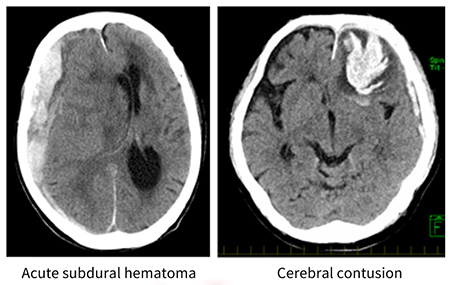
1. From mild to severe head trauma: appropriate treatment for a successful return to society
We perform prompt head CT scans and take appropriate measures to prevent conditions from worsening. If necessary, we perform emergency surgery immediately. Post-surgery, we provide intensive neurological care using neural monitoring systems to ensure the best possible recovery. Even after acute-phase treatment, we provide long-term rehabilitation, regenerative medicine, and outpatient care to support patients’ return to society, including those with higher brain dysfunction.
2. Head trauma in the elderly
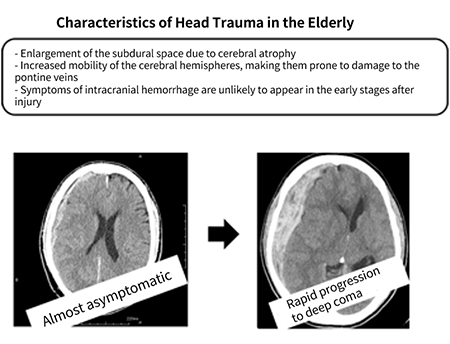
In the elderly, brain atrophy creates a wider space between the skull and the brain, making them more prone to bleeding even from a mild head contusion. Since symptoms may not appear immediately, these cases can be easily overlooked. As a result, patients are often transported to the hospital only after the condition has worsened, leading to lasting sequelae. To prevent such outcomes, our hospital actively admits patients even with mild injuries. We also actively perform head CT scans while utilizing blood biomarkers to aid in the diagnosis of head injuries. Furthermore, as people age, many take anticoagulants(blood-thinning medications), which increases the likelihood of mild cases becoming severe. As a preventive measure, we actively use anticoagulant reversal agents(medications that counteract the effects of anticoagulants)to prevent symptoms from worsening.
3. Pediatric head trauma
Children, especially infants, develop rapidly every day—to the point where they can do today what they couldn’t do yesterday. Therefore, just because a baby couldn’t roll over yesterday doesn’t mean they won’t be able to today. There are many injuries that can be prevented with just a little care from family members.
Compared to adults, young children have larger heads and a higher center of gravity. Additionally, since their motor skills are still underdeveloped, it’s easy to imagine that they are prone to falling. Furthermore, while their skulls are thinner than those of adults, they are also softer. Consequently, comminuted skull fractures-common in adults-are rare in children; instead, we often see depressed fractures. These are known as “ping-pong ball fractures.” Since a baby’s brain continues to grow and develop, in some cases, the brain can naturally correct the depression without surgery. If surgery is necessary, a small incision is made in the skin, and an instrument is inserted beneath the skull to gently push it upward and repair the fracture.
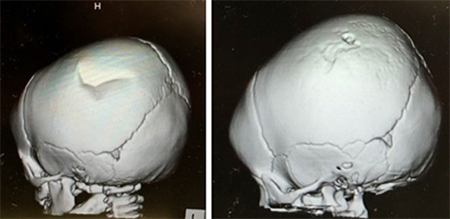
The image on the left shows a skull fracture that occurred during forceps delivery. The image on the right is a post-operative view, showing that an instrument was inserted through a small opening to lift the skull from below and repair it.
Additionally, if an infant or toddler falls and suffers a head contusion, subdural effusion or a subdural hematoma-where cerebrospinal fluid or blood accumulates beneath the dura mater(the tough membrane surrounding the brain)-may occur. Therefore, if an increase in head circumference is observed during a routine checkup, the child should be referred back to a neurosurgeon for a thorough examination.
Sports concussion
A sports concussion refers to a condition in which brain function is impaired due to a strong impact to the head, face, neck, or other part of the body during sports-related activities. Symptoms of sports concussion are diverse and include not only loss of consciousness but also memory impairment, disorientation, slowed reaction time, irritability, balance disorders, headaches, dizziness, and sleep disturbances. In most cases, symptoms appear early after the injury and resolve spontaneously over time; however, in rare cases, symptoms may progress over a period of several minutes to several hours or persist for an extended period. Sports concussions do not show structural abnormalities on standard imaging tests. Diagnosis is based on a comprehensive evaluation of the various symptoms. Because it is difficult for non-medical personnel to make a diagnosis at the scene, the SCAT(Sports Concussion Assessment Tool)is used to enable even laypeople to conduct an assessment. If a concussion is suspected, play must be stopped immediately upon injury, and the player is prohibited from returning to play on the same day. It is crucial to rest while following the instructions of medical staff experienced in concussions. Returning to competition while symptoms persist is associated with a 3 to 5.8-fold increased risk of sustaining another concussion. Repeated concussions can further delay recovery and may result in permanent sequelae. When returning to competition, athletes are permitted to do so only after completing a process of at least one week, following a phased return-to-play program.