- HOME
- Departments & Centers
- Neurosurgery
- Neuroendoscopic surgery
Neurosurgery
Neuroendoscopic surgery
We provide specialized treatment for conditions such as brain tumors, cerebral hemorrhage, and hydrocephalus, performed by physicians certified by the Japanese Society of Neuroendoscopy(JSNE). We utilize both rigid endoscopes, which feature a straight lens, and flexible endoscopes, which have an articulating tip, selecting the appropriate type based on the surgical technique. Rigid endoscopes offer higher resolution than flexible endoscopes and are available in outer diameters of 2.7 mm and 4 mm. Additionally, by using oblique endoscopes with angled tips(30°, 45°, 70°), we can perform lateral views. While flexible endoscopes are slightly inferior to rigid endoscopes in terms of resolution, they offer the advantage of allowing the tip to be freely bent to observe the affected area. At our hospital, we use the latest video endoscopes for flexible endoscopy, which offer high resolution and excellent image quality.
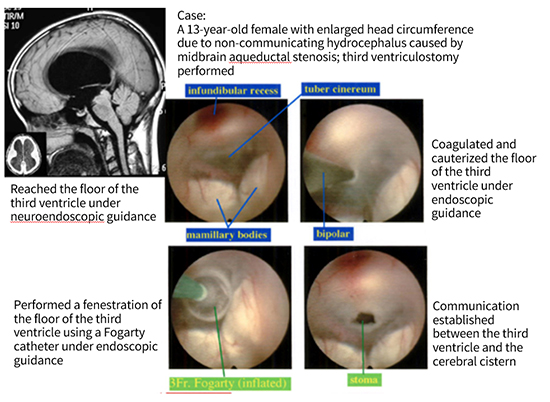
We are also actively performing third ventriculostomy for obstructive hydrocephalus. Traditionally, the primary treatment for obstructive hydrocephalus was ventriculoperitoneal shunt surgery, which involves placing a tube under the skin to connect the ventricles to the abdominal cavity; however, this method allows for a shorter procedure time and a less invasive treatment.
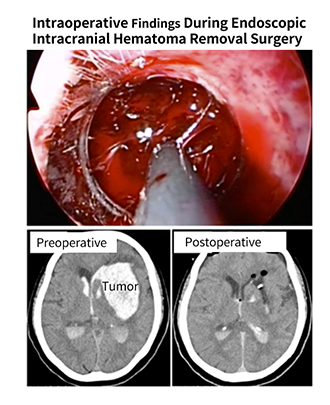
For intracerebral hemorrhage, we actively perform endoscopic intracerebral hematoma evacuation, which involves making a coin-sized incision in the head and inserting an endoscope through that site to remove the hematoma. This method allows for hematoma removal in a shorter time and with less invasiveness compared to conventional craniotomy. Because it is a minimally invasive procedure, patients can begin rehabilitation with early ambulation after surgery, contributing to improved patient outcomes.
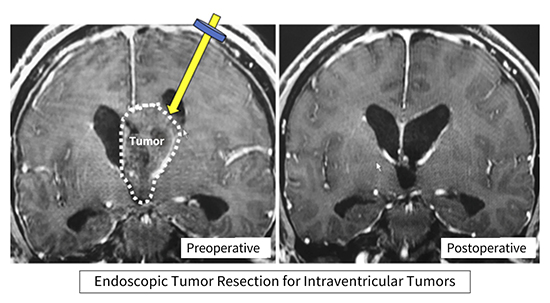
For intraventricular tumors, we actively perform endoscopic intraventricular brain tumor resection. In this method, a sheath is inserted through a hole in the skull into the ventricles to perform the surgery. Compared to conventional craniotomy and microsurgery, this approach minimizes brain damage and allows for more reliable resection of deep-seated brain tumors. The results of this endoventricular brain tumor resection have been highly acclaimed at academic conferences both in Japan and abroad.