- HOME
- Departments & Centers
- Neurosurgery
- Pituitary tumors and related conditions
Neurosurgery
Pituitary tumors and related conditions: Pituitary tumors, craniopharyngiomas, etc.
Thanks to advances in neuroendoscopy and surgical techniques, we perform transnasal endoscopic surgery-a minimally invasive procedure performed through the nose-for pituitary tumors and many other skull base tumors. Transnasal endoscopic surgery is possible for pituitary tumors in the vast majority of cases.
Our hospital specializes in endoscopic-only transnasal surgery, in which the entire procedure-from start to finish-is performed using an endoscope. By manipulating the surgical site within the nasal cavity using an endoscope, we minimize the burden on the nose. Furthermore, performing the entire procedure-from tumor resection to post-resection closure-via endoscopy allows us to visually observe a wide area during surgery, ensuring safe manipulation. As a result, there have been no cases of surgical death or serious complications such as loss of consciousness or paralysis. Furthermore, by performing a specialized technique called dural suturing to close the sella turcica after tumor removal, we have been able to reduce the risk of cerebrospinal fluid leakage-a major complication of this surgery-to 0.4%.
We thoroughly assess postoperative pituitary function and administer appropriate hormone replacement therapy. By maintaining optimal levels of growth hormone, thyroid hormone, adrenal cortex hormone, gonadal hormone, and antidiuretic hormone, we ensure that our patients’ quality of life is fully preserved.
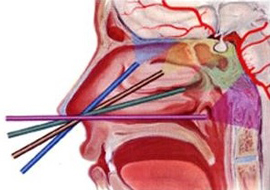
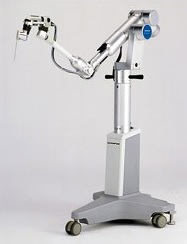
We perform surgery for pituitary and skull base tumors by inserting a 4mm-diameter endoscope(manufactured by Olympus, with its EndoArm grasping device)through the nasal cavity.
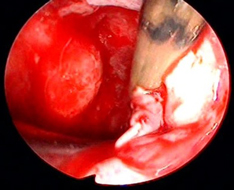
We perform extracapsular resection of pituitary adenomas to improve tumor removal while preserving normal pituitary function.
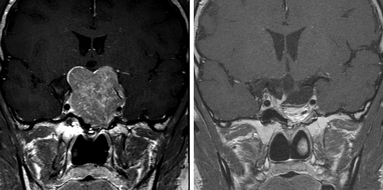
Pre-and post-operative views
of transnasal endoscopic surgery
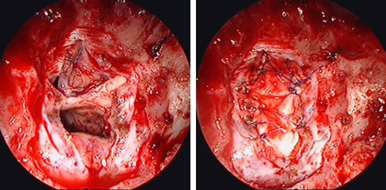
and prevention of cerebrospinal fluid leakage:
Patchwork suturing using fascia
Skull base tumors(craniotomy)
Special outpatient clinic for brain and skull base tumors(in Japanese)
Skull base tumors(transnasal endoscopic surgery)
Skull base tumors include craniopharyngiomas and sellar meningiomas. Because these tumors are located deep within the skull, traditional craniotomy-which involves making a large incision in the skull and pushing aside the brain, nerves, and blood vessels to remove the tumor-was previously necessary. However, depending on the tumor’s size, it is now possible to remove it with less physical strain by performing the surgery through the nose. Furthermore, since transnasal surgery approaches the tumor from below, there is no need to push aside the brain, nerves, or blood vessels, resulting in even less physical strain. During surgery, we use navigation systems, nerve monitoring, and Doppler ultrasound to enhance safety. Patients are able to walk the day after surgery and, if there are no complications, can be discharged within seven days. While the risk of cerebrospinal fluid(CSF)leakage in this procedure is reported to be higher than in pituitary tumor surgery-at 30%-our hospital has successfully eliminated CSF leakage by suturing fascia harvested from the thigh in a patchwork-like manner.
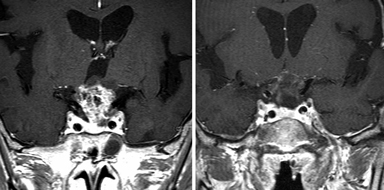
Preoperative and postoperative views
of transnasal endoscopic surgery
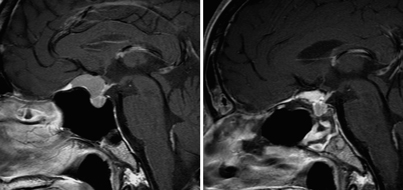
Preoperative and postoperative views
of transnasal endoscopic surgery
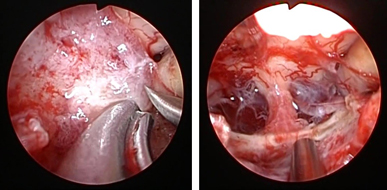
for a sella turcica meningioma:
After tumor resection:
The pituitary stalk, optic nerve,
and internal carotid artery are visible