- HOME
- Departments & Centers
- Cardiac Surgery
- Ischemic heart disease
Cardiac Surgery
Ischemic heart disease
What are the coronary arteries?
1. The heart is a hard worker
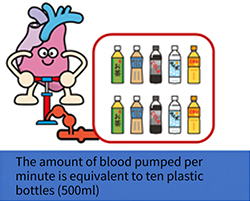
The heart’s role is to pump blood throughout the body; in other words, it acts as a blood pump.
The heart pumps 5-liters of blood per minute(that’s the equivalent of ten plastic 500ml bottles!!). The heart is a tireless worker, continuously pumping this vast amount of blood day and night. To perform such a task, it requires a great deal of energy. How exactly does the heart generate the energy it needs?
2. Energy supply routes to the heart

The heart’s energy sources are carbohydrates and fats, but oxygen is also needed to utilize them. These are contained in the blood that is transported to the heart. In other words, unless a large volume of blood flows into the heart muscle, the heart cannot perform this heavy workload.
Blood is delivered to the heart muscle through thin arteries about 1–2 mm in diameter that run along its surface. In other words, the heart sucks up nutrients through these thin tubes, much like a straw.
3. Coronary arteries
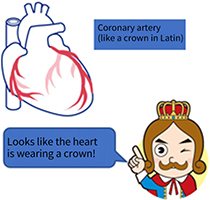
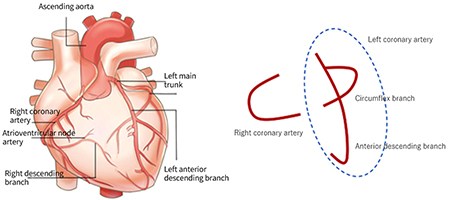
Three thin arteries run along the surface of the heart. They are called coronary arteries because they make the heart look as if it is wearing a crown. These coronary arteries supply blood to the heart.
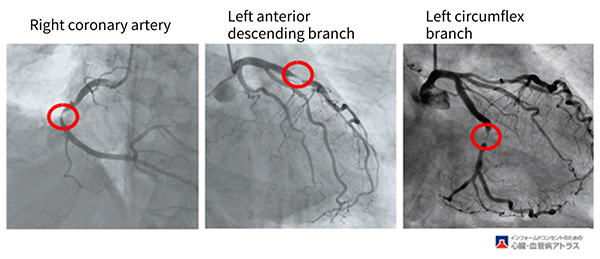
There are two coronary arteries: the left coronary artery and the right coronary artery. The left coronary artery immediately branches into the left anterior descending artery and the circumflex artery.
What is the ischemic heart disease?
1. A disease caused by blocked coronary arteries: Ischemic heart disease
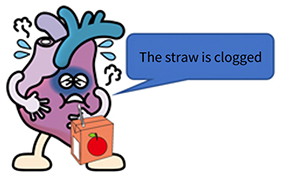
The coronary arteries, which carry a wealth of nutrients, can be described as the heart’s “lifeline,” much like gas or water lines. However, these arteries are very narrow and become more susceptible to damage with age. When blood flow through the coronary arteries is impaired and they can no longer deliver sufficient blood, the heart cannot function properly due to a lack of energy. This condition is known as ischemic heart disease, and its most common forms include angina and myocardial infarction.
2. The main cause: atherosclerosis
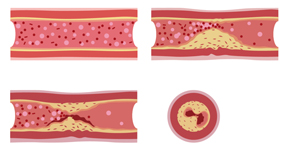
The main cause of coronary artery blockage is atherosclerosis. In atherosclerosis, clumps of fat, such as cholesterol, accumulate within the walls of blood vessels. As a result, the inner lumen of the vessel narrows, preventing more than a certain amount of blood from flowing through. Furthermore, the walls built up with fat become fragile and may rupture. If a rupture occurs, the blood flowing through that area reacts and clots, causing the blood vessel to become completely blocked.
3. Two types of ischemic heart disease
Ischemic heart disease is divided into two categories: stable angina, which has a chronic course with symptoms remaining stable over a long period, and acute coronary syndrome, which develops suddenly and causes symptoms to deteriorate rapidly within a short time.
- a. Stable angina
-
When fat accumulates on the vessel walls and narrows the lumen, blood flow to the heart is restricted. For example, when exercise causes an increase in heart rate or blood pressure, the heart’s workload increases, but it is no longer supplied with sufficient blood. This condition is called angina.
Insufficient blood flow causes chest pain. A typical symptom is a squeezing pain in the chest during activities such as exercise, which subsides within a few minutes at rest. Some people may experience this not as pain, but as heaviness, pressure, or discomfort. While the typical location of the pain is the front of the chest, it may also be felt as pain in the upper abdomen, shoulders, throat, or teeth.

- b. Acute coronary syndrome
-
When the fatty deposits accumulated on the blood vessel walls rupture, the flowing blood reacts and clots. Because blood flow suddenly decreases, symptoms progress rapidly. In particular, the condition where a blood vessel becomes completely blocked and the heart muscle dies is called a myocardial infarction.
Typically, sudden, severe chest pain occurs, sometimes accompanied by cold sweats or vomiting. Rest does not necessarily improve blood flow, and in this case, the chest pain persists for a long time.

Treatment of the stable angina
What treatment options are available?
To determine the treatment plan, coronary arteries are visualized using CT or catheterization to identify the number, location, and degree of stenosis of the lesions. Additionally, the treatment plan is determined by comprehensively evaluating the degree of myocardial ischemia, cardiac function, and the presence of comorbidities.
1. Medical treatment
Medical treatment is a crucial cornerstone of stable angina management. When applied to the appropriate cases, it can be as effective as revascularization therapy in preventing myocardial infarction and cardiac death.
- a. Management of atherosclerosis risk factors
Strictly manage hypertension, diabetes, smoking, and hyperlipidemia. - b. Angina medications
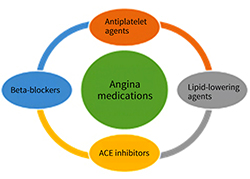
1. Antiplatelet drugs that thin the blood
2. Beta-blockers that reduce the heart’s workload
3. Lipid-lowering drugs(statins)that reduce cholesterol and other lipids These three form the foundation of treatment.
In addition, there are ACE inhibitors with cardioprotective effects and antianginal drugs(nitrate preparations)that relieve chest pain symptoms.
2. Revascularization therapy
If sufficient therapeutic effects cannot be achieved with medical treatment, revascularization therapy is performed to directly increase blood flow. Revascularization therapy is actively considered in cases involving lesions in the main coronary arteries or in patients with poor cardiac function.
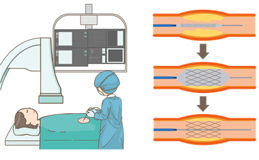
a. Catheter-based treatment(PCI)
A catheter with a balloon at its tip is used to dilate the narrowed area. At this time, a mesh tube called a stent is placed at the dilated site to prevent the narrowed area from narrowing again.
b. Bypass surgery(CABG)
A blood vessel is harvested from another part of the body and anastomosed to the heart’s blood vessels to reconstruct a new blood flow pathway.
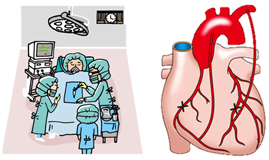
Coronary artery bypass surgery
1. Treating angina with surgery
“Treating angina with surgery”: the dream-like treatment that had been attempted countless times before was finally realized on May 7, 1967, by Argentine cardiac surgeon René Favaloro. Coronary artery bypass surgery had succeeded. At the Cleveland Clinic in the United States, where the surgery was performed, as many as 150 patients flocked there the following year seeking the procedure. It was an event that symbolized the dawn of a new era in the field of cardiac surgery.
Fifty years have passed since then. Coronary artery bypass surgery has undergone various advancements. Sutures and needles have been improved, arterial grafts have been introduced, and bypass anastomosis during beating heart surgery has become possible. Currently, 800,000 coronary artery bypass surgeries are performed worldwide each year, and 15,000 in Japan annually, making it one of the most well-known surgical procedures.
2. What is the coronary artery bypass surgery?
Coronary artery bypass surgery is a procedure in which a bypass vessel is directly anastomosed beyond the narrowed section of a coronary artery to create a new blood flow pathway.
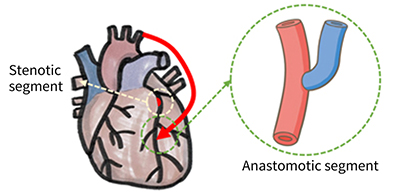
3. The bypass vessel is harvested from a site other than the heart
Coronary arteries are very narrow, with an internal diameter of only about 1.5 to 2.0 mm. Currently available artificial vessels are at least 6 mm in diameter, even the thinnest ones, making them much thicker than coronary arteries and unsuitable for heart bypass surgery.
Therefore, a blood vessel from the patient’s own body is harvested from a site other than the heart and used as the graft vessel.
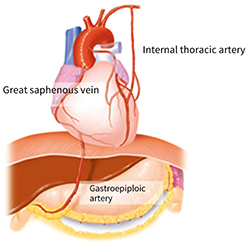
4. What types of blood vessels are used?
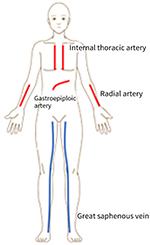
In Favaloro’s surgery, the great saphenous vein was used as the bypass graft. However, Floyd Loop of the same Cleveland Clinic later demonstrated that the internal thoracic artery lasts longer than the great saphenous vein and leads to improved postoperative outcomes. Of course, there are limitations on the vessels that can be used, and currently, the following four types of vessels are available:
①Internal thoracic artery: Runs along the front and back of the chest wall and is located in front of the heart
②Radial artery: Runs along the outer side of the forearm. This is the artery you feel when taking your pulse at the wrist
③Gastroepiploic artery: One of the four arteries that run around the stomach
④Great saphenous vein: A vein that runs along the inner side of the leg
5.What is off-pump surgery?
In conventional heart surgery, surgical procedures are performed while the heart is stopped. While the heart is stopped, a heart-lung machine (i.e., a pump)is used to maintain systemic blood circulation. Since the days of Fabaloro, bypass surgery has also involved stopping the heart to perform anastomosis.
By the 1990s, it became possible to perform bypass anastomoses while the heart was still beating, without using a heart-lung machine(off-pump surgery). To perform anastomosis on a beating heart, specialized devices are used, such as a stabilizer to suppress the movement of the heart at the anastomosis site, and a positioner to rotate the heart so that anastomosis can be performed on the vessels on the back of the heart.


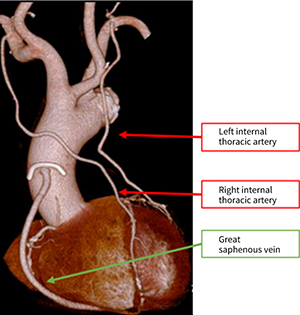
6. Using multiple arterial grafts
The longevity of the vessels used for bypass surgery varies depending on the type of vessel.While approximately half of the great saphenous veins deteriorate within 10 years post-surgery, more than 90% of internal thoracic arteries remain in good condition 10 years after surgery.
The choice of blood vessel used for the bypass significantly affects treatment outcomes, particularly over the long term. It is crucial in surgical planning to use multiple arterial grafts to cover as wide an area as possible.